
Original article published on Purist
What if you could give your brain a reset? Not in a sci-fi sense, but in a real, targeted way that gently reactivates the neural circuits shaping how you think, feel and function every day. That is the promise of transcranial magnetic stimulation, or TMS, a noninvasive, medication-free therapy that is changing how mental health is treated.
A different path for a widespread problem
Depression is now the leading cause of disability worldwide, affecting an estimated 332 million people. For many, and especially for the roughly 30 percent living with treatment-resistant depression, finding lasting relief can mean years of trial and error, often with conventional treatments falling short.
TMS offers another option. FDA-cleared since 2008, it uses painless magnetic pulses to stimulate the dorsolateral prefrontal cortex, the brain's executive control center. This region governs mood, focus and impulse control, and it is often underactive in people with depression. By targeting it directly, TMS helps "wake up" parts of the brain that have gone quiet.
How it works
The brain runs on electricity, and TMS works with that natural wiring. An applicator placed against the scalp delivers a small, painless current into the brain tissue, stimulating neurons and nudging their activity back toward stable, healthy levels. The result can be neuroplastic change, a genuine shift in how the brain functions, without medication.
The science behind TMS is well established, but the technology recently took a meaningful step forward. The next-generation Exomind system builds on traditional TMS with a sleeker design, specialized coils that deliver more targeted energy, and AI-driven, real-time brain mapping that personalizes treatment to each individual. Just as importantly, it has dramatically shortened the process. Where older protocols stretched over months, many patients now notice improvements within two to six sessions.
Who it can help
According to Dr. Lea DeFrancisci Lis, a double board-certified adult and child psychiatrist and assistant clinical professor at New York University School of Medicine, modern TMS can benefit almost anyone. That includes people with depression, anxiety and OCD, as well as those seeking support with binge eating and weight management. It is also showing promise in more subtle areas, such as perimenopausal brain fog, sleep disruption, and the focus and burnout challenges faced by executives, professionals and athletes.
TMS pairs well with other treatments, too. For treatment-resistant depression, Dr. Lis describes the combination of TMS and ketamine-assisted psychotherapy as a "dynamic duo." The main exceptions are people with a risk of seizures or stroke, or those with a pacemaker, who are generally not candidates.
What a session feels like
The patient experience is designed to be straightforward and comfortable. After the applicator is positioned, the provider locates the motor cortex, then uses AI brain mapping to set a program tailored to the individual. From there, the patient simply sits for about 28 minutes. The sensation is a light tapping on the head, and the most common side effect is an occasional headache. Most people are advised to complete around six sessions.
A tool for wellness, not just treatment
What makes TMS feel new is not the technology itself but how it is being used. The streamlined six-session protocol has made it far more accessible, and the conversation is shifting from treating illness toward supporting overall brain health. Increasingly, TMS is seen as a proactive part of a wellness and longevity strategy, a kind of tune-up that helps guide the mind into an optimal state.
For anyone who has felt stuck on the long road of conventional treatment, that reframing is worth paying attention to: the future of mental health care may be less about masking symptoms and more about resetting the brain itself.
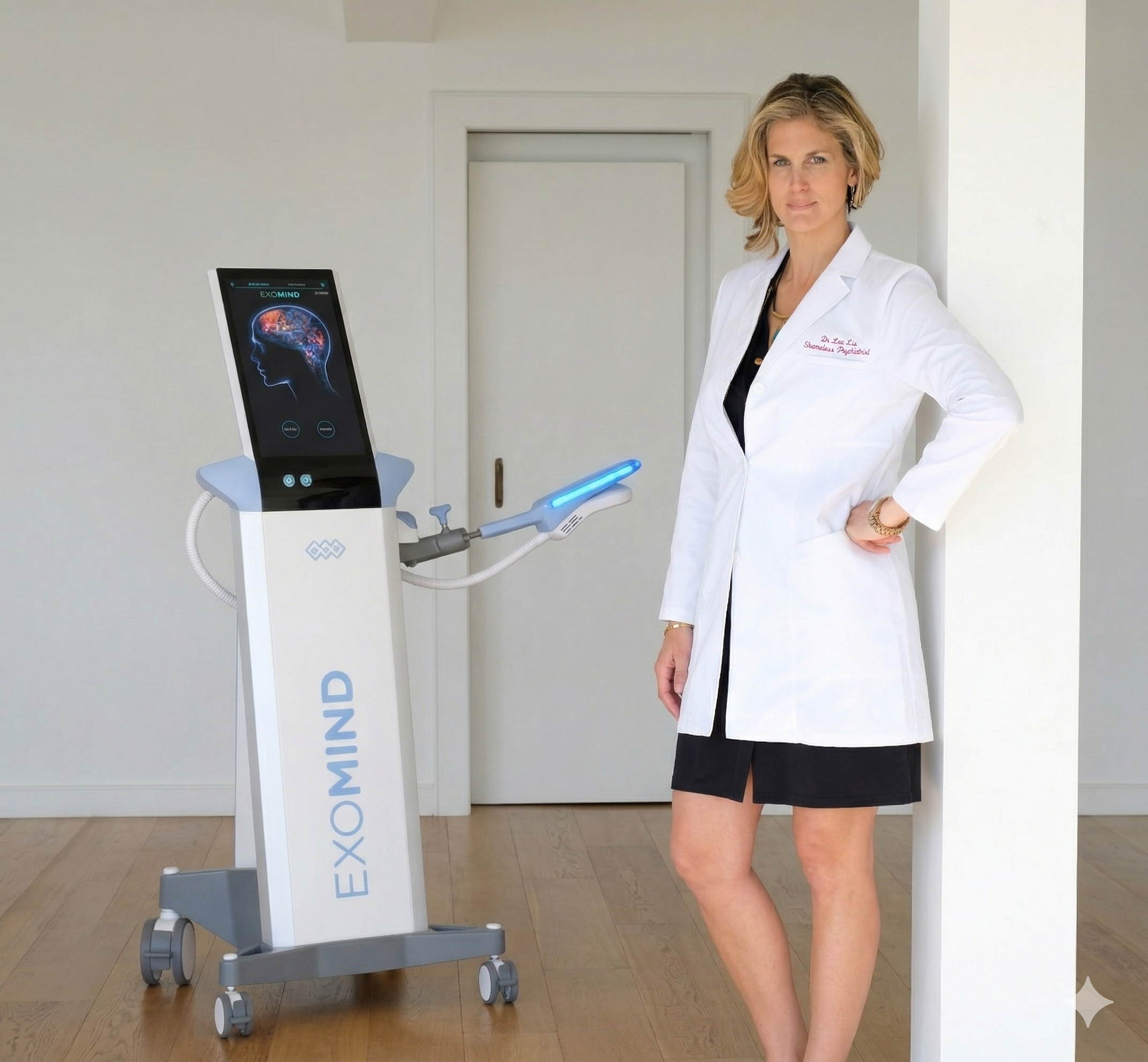
Exomind, a modern TMS, can be used for almost anyone. Photo courtesy of Dr. Lea DeFrancisci Lis